2026-09-30 — 102.2 kWh harvested, 16.5 kW peak, 96.8 kWh used by the house. And 3.2 kWh that never got collected at all.
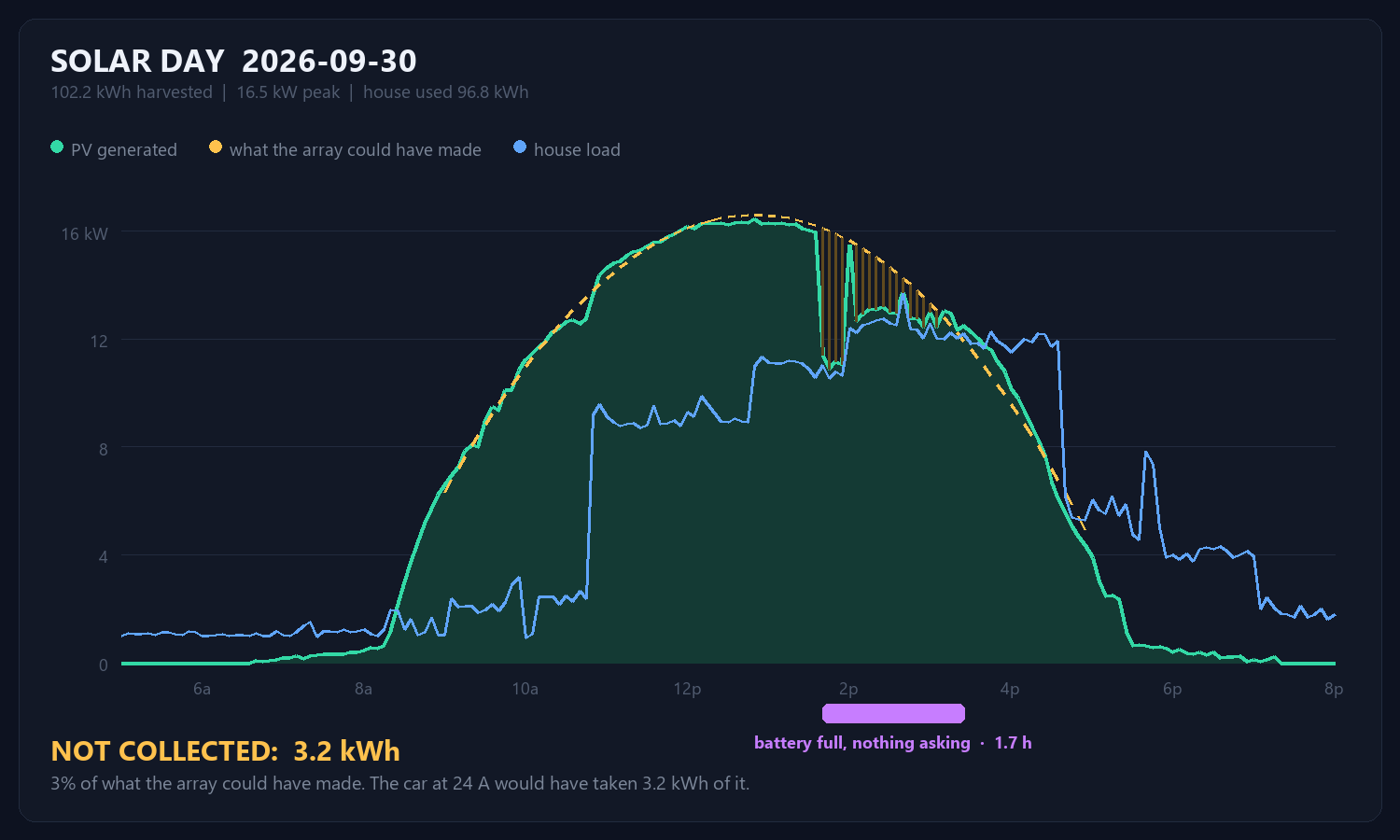
The amber line is what the array could have made; the green is what it did. From 13:40 to 15:25 the two come apart, and the gap between them is energy that was available and simply not taken — 3% of the day’s potential.
Nothing was broken. The battery was full, the house was not asking for much, and a grid-free system with nowhere to put power does the only thing it can: it throttles the array back until generation matches the load. You can watch it happen — through that window PV tracks the house within a couple of hundred watts, and charge power sits at zero.
That is also how you tell curtailment from cloud. Cloud cuts generation while the battery is still hungry. Curtailment only happens when there is nowhere left to put it.
The fix is a load, not a panel
More array would do nothing here; the array is already being told to stop. What is missing is somewhere for the surplus to go between roughly noon and four.
A car is a 60 kWh battery that happens to have wheels. On the 10/4 cord at 24 A it draws 5.76 kW — and the shortfall on this day averaged less than that, so plugging in through the curtailed window would have absorbed 3.2 of the 3.2 kWh. That is about 11 miles of driving that otherwise evaporated as heat the panels never made.
Charging the car at midnight is the habit. On a system like this it is exactly backwards: midnight charging comes out of the battery, while noon charging comes out of sunlight that is currently being refused.